
 Torzon
 WeTheNorth
 DrugHub
 Nexus
Nexus BlackOps
What is the Hidden Wiki?
The Hidden Wiki is a curated directory of .onion websites accessible only through the Tor network. It functions as a navigational index for the dark web, organizing hidden wiki links into categorized sections including marketplaces, forums, privacy tools, email services, and whistleblower platforms. For users seeking a complete darknet market list, this type of directory remains essential.
Standard search engines such as Google and DuckDuckGo are unable to index .onion addresses. Deep web links and dark web links remain invisible to conventional crawlers. Without a directory, finding hidden services would mean knowing each site's 56-character address in advance. The Hidden Wiki and directories like Tor8Web address this gap by curating verified, categorized link databases containing only functional darknet links.
How Tor8Web Differs from Legacy Directories
Unlike the original Hidden Wiki, which was community-edited and frequently vandalized, Tor8Web maintains editorial control over every listing. In 2025 alone, over 12,000 phishing clones of popular .onion sites were detected across the dark web. Legacy wikis linked to many of them. Tor8Web's verification process eliminates this risk entirely.
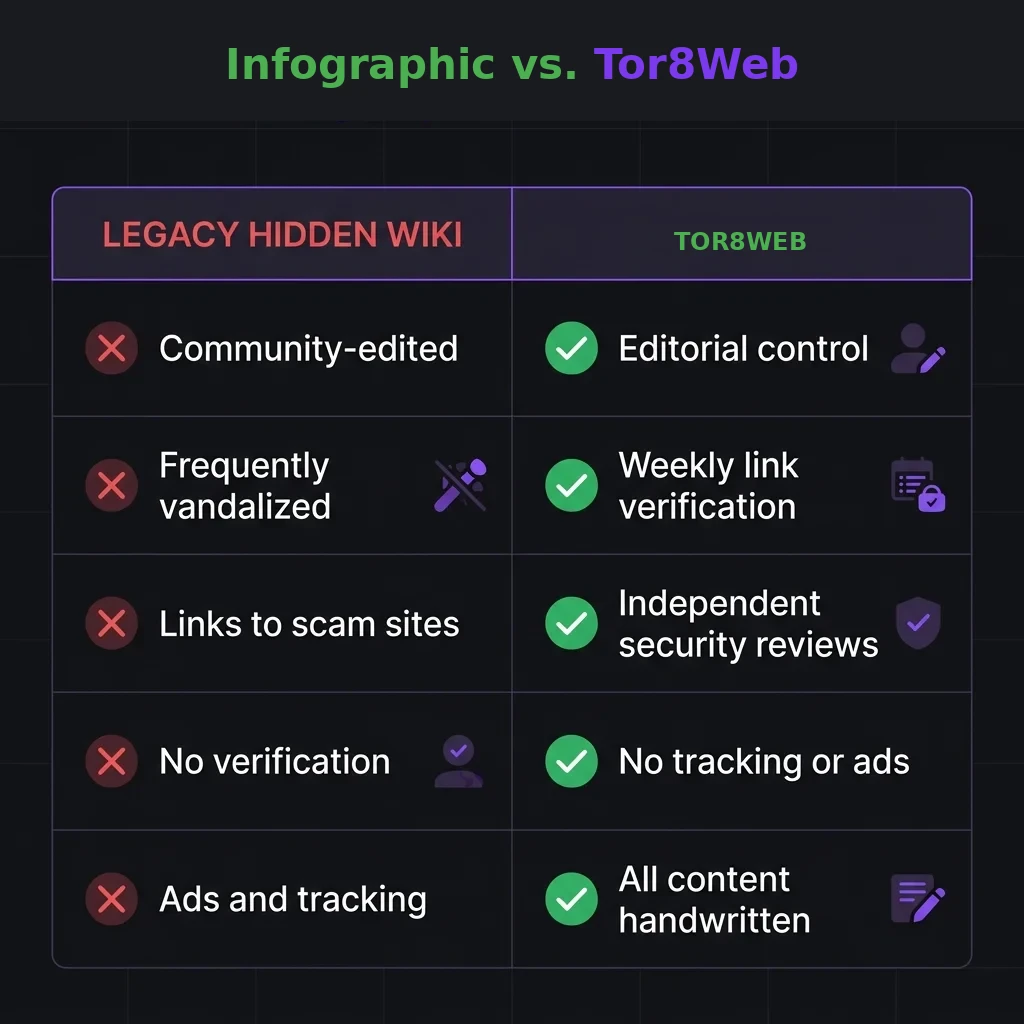
We do not host user-generated content, do not require registration, and do not run tracking scripts. The site is designed to work with JavaScript disabled and loads efficiently over the Tor network. For a deep understanding of darknet terminology, explore our darknet glossary with 160+ defined terms.
How to Access the Dark Web
Accessing .onion sites requires the Tor Browser, a free, open-source browser that routes traffic through an encrypted multi-node network. Over 2 million users connect to the Tor network daily. For a complete setup walkthrough, including Tails OS, Whonix, and VPN configurations, see our step-by-step darknet access guide.
Staying Safe on Tor
The dark web is inherently unstable. Sites can vanish overnight, URLs shift without notice, and phishing clones spread rapidly. Our market shutdown timeline documents every major takedown since 2013. Essential precautions include:
- Never share personal information or use real-world identities
- Verify .onion links through multiple independent sources (Dread, Tenebris, Dark.fail)
- Use PGP encryption for all communications (anti-phishing guide)
- Run Tails OS or Qubes for hardware-level isolation
- Prefer Monero (XMR) over Bitcoin for transaction privacy
- Understand escrow mechanics before any marketplace interaction
Our OPSEC Fundamentals guide covers these practices in detail with real-world case studies of operational security failures. For additional safety resources, see our harm reduction hub.